A Field Note on the places where physics and mysticism say the same thing in different languages
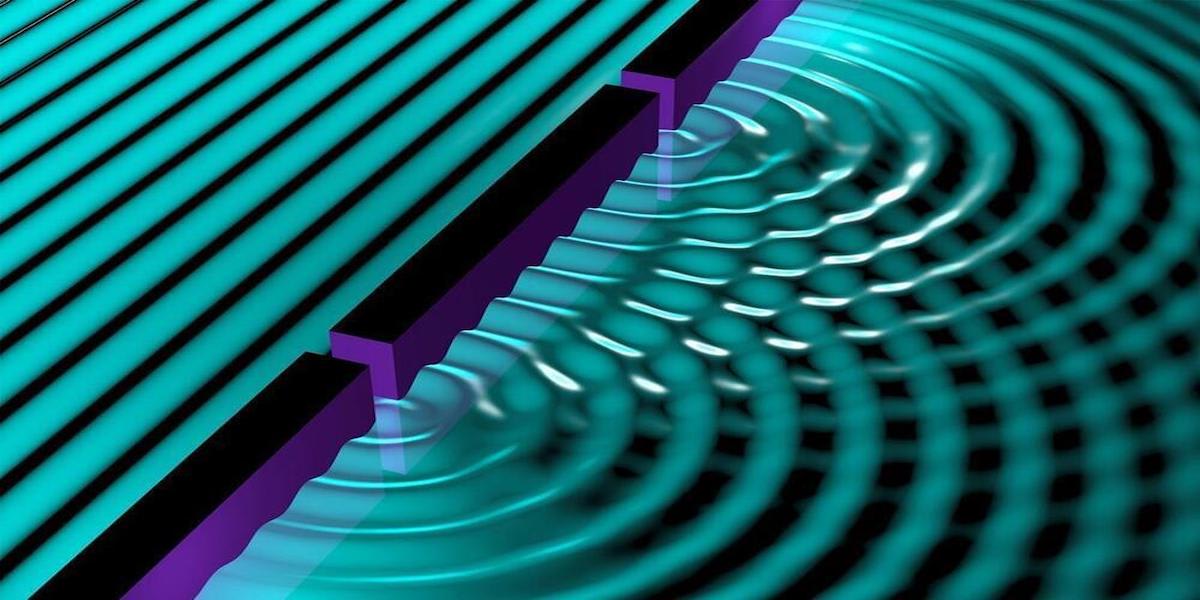
There's a moment I remember from my physics training in college—sitting in a quantum mechanics lecture, listening to my professor explain the double-slit experiment for the hundredth time.
"The electron goes through both slits simultaneously," he said, drawing diagrams on the board. "Until we observe it. Then it 'chooses' one path."
A student raised her hand. "So...observation changes reality?"
The professor paused. "We don't say it that way in physics."
"But that's what happens."
"Yes. But we don't say it that way."
I thought about that conversation for years. Because if you translate what quantum mechanics actually demonstrates into plain language, you get something that sounds less like science and more like the kind of thing a mystic would say after a week-long meditation retreat.
The Observer Effect
Quantum physics tells us that particles exist in superposition—multiple states at once—until the moment they're measured. Then the wave function collapses and the particle "decides" what it is.
Buddhist philosophy says that phenomena have no inherent existence until consciousness interacts with them. That reality arises dependent on observation.
Different terminology. Same implication: consciousness and reality are entangled in ways we barely understand.
Entanglement and Non-Locality
Einstein called quantum entanglement "spooky action at a distance" because he didn't like what it implied: that two particles could remain connected across any distance, affecting each other instantaneously.
Change the spin of one electron, and its entangled partner changes too. Instantly. Even if it's on the other side of the galaxy.
Meanwhile, mystics from multiple traditions have described the universe as fundamentally interconnected—Indra's Net in Buddhism, where every jewel reflects every other jewel. The Web of Wyrd in Norse tradition. Carl Jung's collective unconscious.
They didn't have particle accelerators. But they were describing the same thing.
The Simulation Hypothesis
Modern physicists seriously debate whether we might be living in a computer simulation. The math works. The logic holds. If advanced civilizations can create simulated realities, and do so frequently, then statistically we're more likely to be in a simulation than in base reality.
Ancient Hindu philosophy described Maya—the veil of illusion that makes us mistake the simulation for ultimate reality. Plato's cave, where shadows on the wall seem real until you turn around and see the fire.
Same insight. Different era.
The Participatory Universe
Physicist John Wheeler proposed something radical: that the universe is participatory. That observers don't just watch reality unfold—they help create it through the act of observation.
"We are participators in bringing into being not only the near and here but the far away and long ago," he wrote.
Sounds mystical, doesn't it?
But he wasn't being poetic. He was describing what quantum mechanics actually demonstrates in laboratory conditions, over and over again.
Why This Matters
I write science fiction because I believe the territory between "hard science" and "mystical experience" is where the most interesting questions live.
Not because science is wrong or mysticism is right. But because they're both mapping the same strange terrain from different directions—and neither has the complete picture yet.
What if consciousness isn't just a side effect of brain chemistry? What if it's fundamental to how reality operates?
What if ancient practices for altering consciousness weren't primitive superstition, but early experiments in a science we're only now beginning to understand?
What if the universe really is participatory—and we've been co-creating reality all along without realizing it?
These are the questions my stories explore. Not through academic papers or meditation retreats, but through characters who encounter these mysteries directly and have to grapple with what they mean.
Because the most profound truths often sound like magic until science catches up.
And sometimes, magic sounds like science that hasn't been proven yet.
What resonates for you?
Have you had moments where a scientific concept and a mystical insight seemed to describe the same reality? I'd love to hear about them.
— M. A. Caulder
Join the mailing list to explore further.